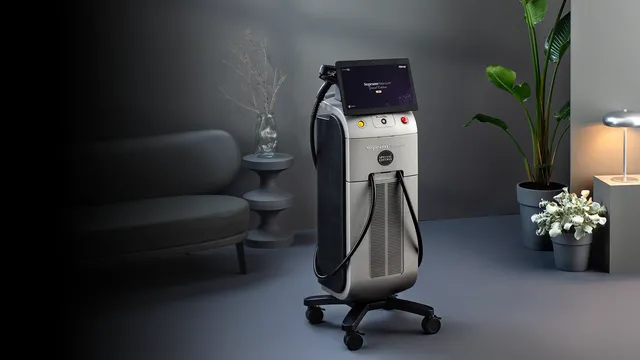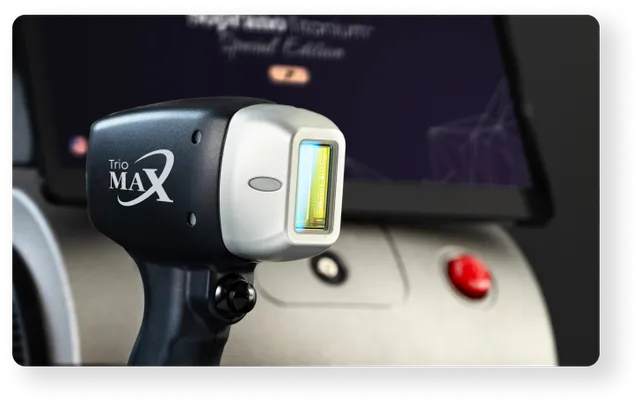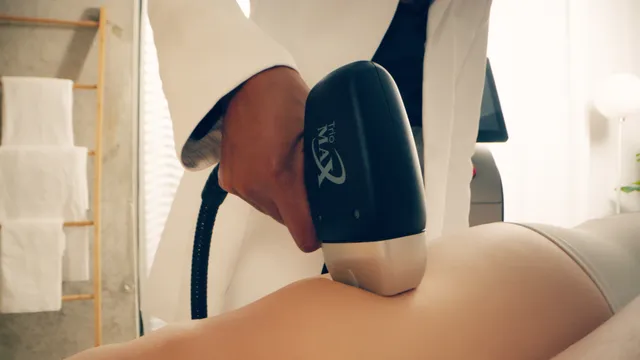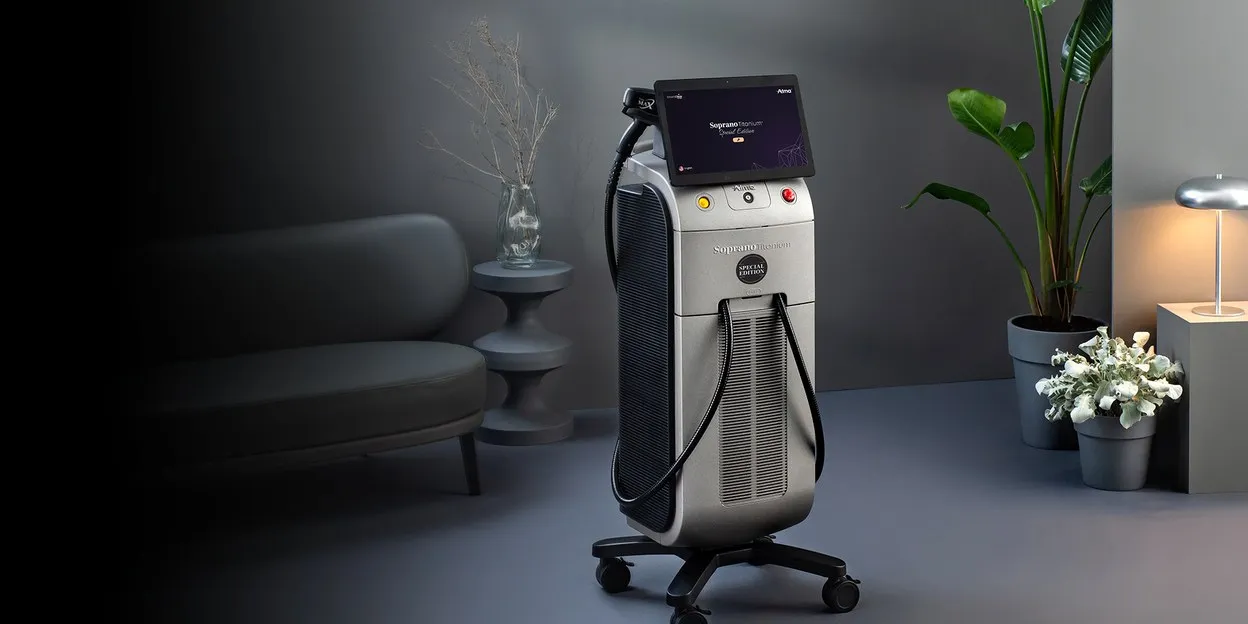
Laser hair removal has a genuine evidence base. It also has limits that marketing tends to skip. Most of that evidence is about laser hair removal in general, not about any one machine, so this guide says plainly where a study used a different device and where a claim is the manufacturer’s. VIVO Body Studio offers the treatment on the Soprano Titanium, and the device’s features are covered in What makes Soprano Titanium different?.
How laser hair removal works: melanin, heat and selective photothermolysis
Laser light passes into the skin and is absorbed by melanin, the pigment in the hair shaft and follicle. The melanin turns the light into heat, which damages the structures that regrow the hair.
The principle behind every hair removal laser, selective photothermolysis, was set out by R. Rox Anderson and John A. Parrish in Science in 1983. Three things have to line up:
- Wavelength: light that melanin absorbs more readily than the surrounding skin does.
- Fluence: enough energy to heat the follicle past the point of damage.
- Pulse duration: short enough to keep the heat in the follicle rather than spreading it.
Melanin is present in growing (anagen) hair, so those follicles are the main target. Because hairs cycle at different times, treatment is repeated over months to catch each follicle as it grows, according to a review of laser treatment in hirsutism. The home page explains the science in more detail.
What “permanent hair reduction” means in the clearance wording
Cleared lasers are indicated for permanent hair reduction, not permanent hair removal. A US Food and Drug Administration (FDA) clearance letter defines it exactly: “the long-term, stable reduction in the number of hairs regrowing when measured at 6, 9, and 12 months after the completion of a treatment regime” (FDA 510(k) K133283).
Two things follow. Reduction means fewer hairs, not none. And the measurement stops at 12 months: the research holds no controlled data running to 5 or 10 years. The FDA describes electrolysis, not laser, as a permanent hair removal method. What reduction looks like over a course is covered in Sessions, results and the longer view.
How much hair reduction the research records, by laser type
Four syntheses give the clearest picture. None of them studied the Soprano Titanium. On funding, the most the research file records for any study in this guide is that the paper’s abstract does not state it.
- Krasniqi and colleagues, 2022 (systematic review): hair reduction ranged from 30 to 73.6% for Nd:YAG, 35 to 84.3% for alexandrite, 32.5 to 69.2% for diode and 27 to 52.7% for IPL (PubMed 35634805). The number of studies and the follow-up are not recorded.
- Kao and colleagues, 2023 (network meta-analysis of 13 randomised trials, 652 participants): diode ranked most effective (PubMed 37493187). Follow-up is not recorded.
- Sadighha and Mohaghegh Zahed, 2009 (meta-analysis): mean reduction of 57.5% for diode, 54.7% for alexandrite, 52.8% for ruby and 42.3% for Nd:YAG (PubMed 18027066). Follow-up is not recorded.
- Dorgham and Dorgham, 2019 (systematic review and meta-analysis): alexandrite outperformed IPL, and Nd:YAG carried a lower risk of darkened skin patches after treatment (JEADV). It pooled 12 comparative trials in Fitzpatrick skin types III to VI, and the lower risk of darkened patches was for Nd:YAG against IPL. Follow-up is not recorded.
The ranges overlap heavily and the rankings disagree. The fairest reading is that matching the laser to the skin type, choosing the settings well and the practitioner’s skill matter more than the platform, and that no platform reliably clears every hair. The hirsutism review puts a single treatment at 10 to 40% reduction, with 30 to 50% clearance generally reported 6 months after the last session.
Who it suits, and whose hair it cannot treat
The American Academy of Dermatology (AAD) says laser hair removal “works best for patients with light-colored skin and dark-colored hair” (AAD FAQs). That is because dark hair holds plenty of melanin, while lighter skin holds less to compete for the light.
Darker skin is not ruled out. Longer-wavelength platforms with cooling have extended treatment across the Fitzpatrick skin scale, from type I (lightest) to type VI (darkest), and some lasers are cleared for all six types. One example is the Lumenis LightSheer, a different device (FDA 510(k) K170179). Courses in darker skin can run longer: a study of 150 people with Fitzpatrick types IV to VI, using long-pulsed Nd:YAG, recorded a mean of 8.9 treatments for a mean reduction of 54.3% (PubMed 21519944). It was a retrospective review at a UK hospital; follow-up and funding are not stated in the abstract.
Hair without enough pigment is the hard limit. A dermatology review calls lasers “ineffective for thin vellus hairs, and white, grey, or red hairs” (Skin Therapy Letter). One randomised trial tried adding artificial pigment: 16 patients, 42 treatment areas, three sessions with an 800 nm diode laser after a liposomal melanin spray. At six months hair was reduced by 14%, against 10% in control areas given a saline spray and the same laser, and the authors called the outcome “disappointing” (PubMed 17452842).
The risks worth knowing before a first session
Straight after treatment the skin is usually red and swollen, which “often looks like a mild sunburn”, according to the AAD. The FDA lists the possible side effects as blistering, discoloration, swelling, redness and scarring.
The AAD is direct about who does the work: “laser hair removal can be dangerous in inexperienced hands. Burns, permanent changes to your skin color, and scars can occur.” A 2023 review catalogues the adverse events reported with laser hair removal (PubMed 37272371).
Turning the power down is not a safe shortcut. Too little energy may cause only temporary hair loss lasting one to three months (Gonçalves, Our Dermatology Online). A retrospective study of 329 patients treated with a long-pulsed alexandrite laser between 2001 and 2004 found that 17 (5.2%) grew more hair on the face and neck after treatment, and its authors named darker skin and below-optimal settings as risk factors. Questions to raise at a consultation:
- Which skin type does the practitioner assess you as, and how does that shape the settings?
- Is a patch test planned before the first full session?
- Who will carry out the treatment, and what experience do they have?
Before your first Soprano appointment covers what to tell the practitioner.
What the Soprano Titanium’s manufacturer publishes, and what it leaves out
Alma, the manufacturer, markets the Soprano Titanium as suitable for “all skin and hair types” and as “virtually painless”, and describes its delivery as SHR In-Motion. These are the manufacturer’s claims, and the general evidence tests each of them:
- Skin types: the Soprano Titanium’s 810 nm applicator is cleared for permanent hair reduction in “all skin types (Fitzpatrick I-VI), including tanned skin” (FDA K222064), so the skin half of the claim has regulatory support for that applicator.
- Hair types: no laser works on non-pigmented hair, as the trial above shows.
- Pain: in a split-body randomised trial of 30 participants, diode laser scored 3.7 for pain against 1.6 for IPL on a visual scale, while reducing hair by 69.2% against 52.7% at 12 months (PubMed 23278132). That trial used a Lumenis LightSheer XC diode laser and an Ellipse Flex PPT IPL, not the Soprano Titanium, so it cannot be read as a Soprano result.
The research found that Alma’s product page does not state the device’s wavelengths. Our research notes that specifications like these should come from the clearance summary or the instructions for use, not a marketing page. The US Food and Drug Administration has cleared the Soprano Titanium twice: on 12 October 2022 (FDA K222064) and on 22 February 2023, adding a 2 cm² Trio handpiece and software (FDA K230371). The summaries describe a diode laser with 755 nm and 810 nm applicators, plus a “Trio” applicator that “delivers three wavelengths simultaneously”; the three are not named in the summary. What each is cleared for differs:
- 810 nm applicator: permanent hair reduction, measured at 6, 9 and 12 months, in “all skin types (Fitzpatrick I-VI), including tanned skin”.
- 755 nm applicator: permanent hair reduction.
- Trio applicator, SHR mode: “temporary hair reduction” only, on an Alma-sponsored single-arm study of 30 subjects (four treatments 6 weeks apart, assessed 3 months after the last).
The Special Edition is not named in either clearance. So the Soprano Titanium sits in the diode family above, and it is fair to ask a clinic which applicator and mode it will use on you. No independent head-to-head trials of today’s branded professional machines were identified, and a peer-reviewed paper notes that “the FDA does not assess or compare clinical efficacy or efficiency” (PMC9537259). “FDA cleared” does not mean “proven better”.
Cost, regulation and safety in brief, with links to the deeper guides
Cost. VIVO Body Studio’s prices are on the home page under pricing. UK market prices by area are covered in How much does laser hair removal cost in the UK?
Regulation in Scotland. Clinics where doctors, dentists, nurses, midwives or pharmacists provide services register with Healthcare Improvement Scotland, as they have since 1 April 2016. From 6 September 2027, non-ablative laser will also need a council licence under the Licensing of Non-surgical Procedures Order (S.S.I. 2026/87). As of November 2026 that licence is not yet required, and anyone who applies before the date can carry on until their council decides. Our guide to laser hair removal regulation covers this in more detail.
Planning a course. Planning laser hair removal in Glasgow sets out what to confirm before booking, and the home page explains what to expect across a course. When to start laser hair removal maps a course onto the UK year.
If you would like to know whether your skin and hair suit laser hair removal, book a consultation and patch test at VIVO Body Studio and bring the questions above.
At a glance
For and
against.
In its favour
- Systematic reviews record substantial hair reduction with every main laser type, not just one
- The cleared claim, permanent hair reduction, has a defined meaning: stable reduction measured at 6, 9 and 12 months
- Cleared lasers exist for the whole Fitzpatrick skin scale, I to VI, so darker skin is not automatically ruled out
Worth weighing
- It does not work on white, grey, red or fine vellus hair, whatever the machine
- No independent trial has tested the Soprano Titanium against other current machines
- Most people see some regrowth, and controlled results stop at 12 months
Common questions
Good questions.
Honest answers.
01Has the Soprano Titanium been tested in an independent trial?
Not in the research we hold. No independent randomised trials comparing today's branded professional machines, the Soprano Titanium included, were found. The studies in this article used other lasers, so they describe laser hair removal in general rather than this device.
02Does FDA clearance mean a laser is proven to work better than others?
No. Clearance in the US is a judgement that a device is substantially equivalent to one already on the market. A peer-reviewed paper on hair removal methods states that the FDA does not assess or compare clinical efficacy or efficiency.
03Can the Soprano Titanium treat white or grey hair?
The manufacturer markets it for all skin and hair types, but that is its claim. A dermatology review describes lasers as ineffective for thin vellus hairs and for white, grey or red hairs, because they have too little melanin to absorb the light. Electrolysis is the realistic option for hair without pigment.
04Does a laser hair removal clinic in Scotland need to be registered?
Clinics where doctors, dentists, nurses, midwives or pharmacists provide services register with Healthcare Improvement Scotland, as they have since 1 April 2016. From 6 September 2027, non-ablative laser will also need a council licence under S.S.I. 2026/87. As of November 2026 that licence is not yet required.